Explore the rich history of Ronda, from its Roman and Moorish heritage to its iconic bridges and historic landmarks. Discover the stories that shaped this Andalusian town.
Almost every visitor to Ronda will hear about the beauty of the nearby village called Grazalema. The village is located within the western reaches of the Sierra de Cadiz that also includes the villages of El Bosque, Zahara de la Sierra, Algodonales, and Olvera, and is the north-eastern tip of Cadiz province.
I’ve been living in this lovely area of Western Andalucia for the last 20 years or so and dedicate most of my time to the running of English language tourist information websites for the towns of Cádiz, Ronda, Grazalema, the famous or infamous Caminito del Rey, and also Wildside Holidays, which promotes sustainable and eco-friendly businesses running wildlife and walking holidays in Spain. My articles contain affiliate links that will help you reserve a hotel, bus, train or activity in the area. You don’t pay more, but by using them you do support this website. Thankyou!
Ronda’s Arab Baths (Baños Árabes) are one of the best-preserved medieval Islamic bath complexes in the Iberian Peninsula. Located beside the Puente Árabe in the former Muslim suburb of San Miguel, the baths give a fascinating insight into daily life in medieval Ronda and the importance of bathing, cleanliness and socialising in an Islamic city.
The baths date from the 13th and 14th centuries and retain much of their original layout and hydraulic system. The complex includes separate cold, warm and hot rooms, together with the remains of the furnace, aqueduct and water-lifting system that supplied the hammam. The surviving star-shaped skylights, horseshoe arches and water system make it one of the most interesting Moorish monuments in Ronda.
I’ve been living in this lovely area of Western Andalucia for the last 20 years or so and dedicate most of my time to the running of English language tourist information websites for the towns of Cádiz, Ronda, Grazalema, the famous or infamous Caminito del Rey, and also Wildside Holidays, which promotes sustainable and eco-friendly businesses running wildlife and walking holidays in Spain. My articles contain affiliate links that will help you reserve a hotel, bus, train or activity in the area. You don’t pay more, but by using them you do support this website. Thankyou!
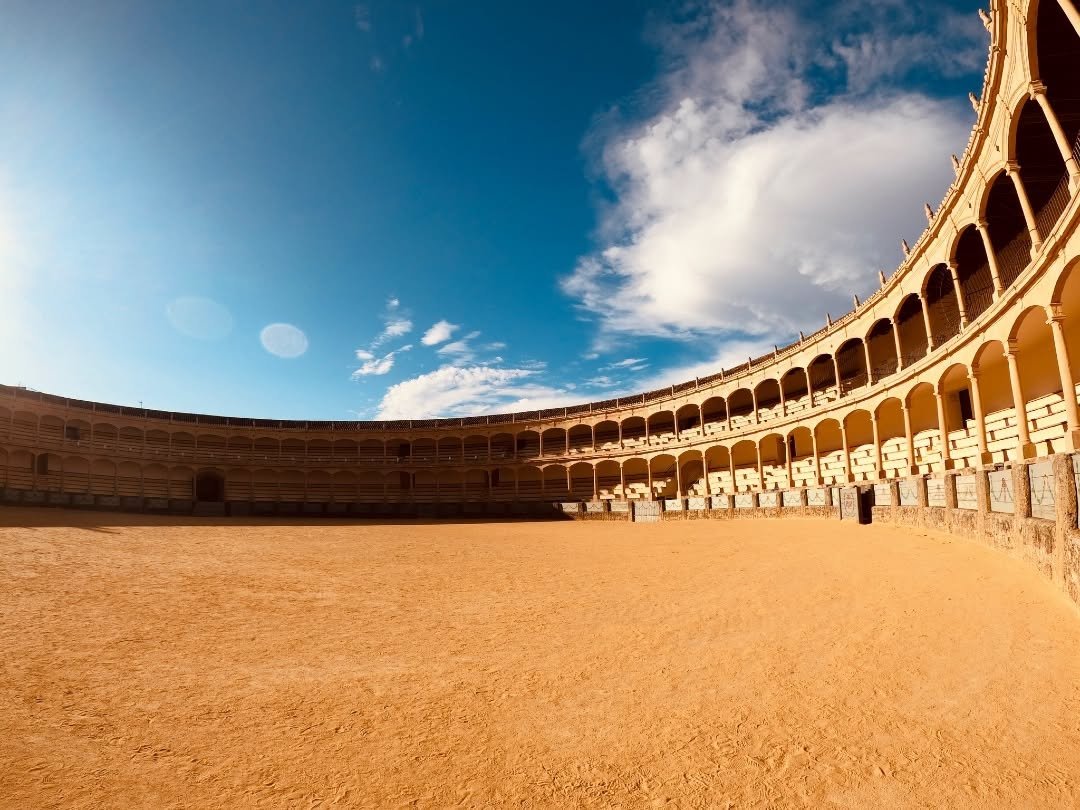
The Plaza de Toros in Ronda is one of the city’s most important historic landmarks and one of the most significant bullrings in Spain. Built in the 18th century, it is closely associated with the Romero family and the development of the Ronda style of bullfighting.
Today, visitors can explore the historic bullring and its museum to learn about Ronda’s role in Spanish culture and the history of bullfighting. You don’t need to be interested in bullfighting itself to appreciate the building, its architecture and its place in Ronda’s history.
Visiting the Plaza de Toros
A visit to the bullring includes access to the arena and museum, where you can learn more about Ronda’s bullfighting history and the Romero dynasty.
Planning your visit to Ronda? The Plaza de Toros is one of the city’s key historic attractions. See our Top 10 places to visit in Ronda for more ideas on what to see and do during your stay.
Agatha Christie: The Seven Dials was filmed in Ronda
Ronda’s Plaza de Toros features in the Netflix miniseries Agatha Christie: The Seven Dials, an adaptation of Agatha Christie’s novel The Secret of Chimneys. Several scenes were filmed in Ronda in September 2024, with the Plaza de Toros among the city’s historic locations used by the production.
The bullring is particularly relevant to the story because the plot has a connection with bullfighting, and it appears in the opening scenes of the series. Other recognisable Ronda locations include the Puente Nuevo, Alameda del Tajo, Arab Baths, Casa del Rey Moro and the area around the Arco de Felipe V.
Would you like to visit a fighting bull farm in Ronda?
Reservatoro Ronda is a working breeding farm for fighting bulls and purebred Andalusian horses, located around 5 km from Ronda. Created by retired bullfighter Rafael Tejada, the farm is open to visitors who can learn about the breeding of fighting bulls and the selection process, while seeing the animals and horses at close quarters.
A visit offers a very different perspective on the traditional world surrounding Ronda’s bullfighting culture and takes you into the countryside just outside the city.
Reservatauro Ronda is an active breeding farm for fighting bulls and purebred Andalusian horses, situated just 5 kilometers from Ronda.
I’ve been living in this lovely area of Western Andalucia for the last 20 years or so and dedicate most of my time to the running of English language tourist information websites for the towns of Cádiz, Ronda, Grazalema, the famous or infamous Caminito del Rey, and also Wildside Holidays, which promotes sustainable and eco-friendly businesses running wildlife and walking holidays in Spain. My articles contain affiliate links that will help you reserve a hotel, bus, train or activity in the area. You don’t pay more, but by using them you do support this website. Thankyou!
Ronda’s position on a dramatic gorge made it naturally difficult to attack, while its defensive walls and city gates strengthened its protection. Together, the cliffs, the Guadalevín River and the fortified walls helped make Ronda one of the most strategically important towns in the region.
Although earlier settlements had their own forms of defence, many of the surviving stone walls and gates around Ronda date from the Islamic period, which lasted here from the early 8th century until the Christian conquest in 1485.
I’ve been living in this lovely area of Western Andalucia for the last 20 years or so and dedicate most of my time to the running of English language tourist information websites for the towns of Cádiz, Ronda, Grazalema, the famous or infamous Caminito del Rey, and also Wildside Holidays, which promotes sustainable and eco-friendly businesses running wildlife and walking holidays in Spain. My articles contain affiliate links that will help you reserve a hotel, bus, train or activity in the area. You don’t pay more, but by using them you do support this website. Thankyou!
Experience the magic of Ronda Romántica 2025! From May 30 to June 1, Ronda, Spain, comes alive with parades, flamenco, historical reenactments, and 19th-century charm. Plan your visit now!
The town of Ronda, with its rich history, culture, and natural beauty, has been inspired by many writers and poets. “The Spanish Trilogy” by Rainer Maria Rilke, which includes a section dedicated to Ronda, contains poetry about the town. The town’s history, architecture, surrounding landscapes, and beauty of the natural surroundings are reflected upon in the poem.
I’ve been living in this lovely area of Western Andalucia for the last 20 years or so and dedicate most of my time to the running of English language tourist information websites for the towns of Cádiz, Ronda, Grazalema, the famous or infamous Caminito del Rey, and also Wildside Holidays, which promotes sustainable and eco-friendly businesses running wildlife and walking holidays in Spain. My articles contain affiliate links that will help you reserve a hotel, bus, train or activity in the area. You don’t pay more, but by using them you do support this website. Thankyou!
Discover the Rich History and Charm of Ronda, Spain
Visiting Ronda is like stepping back in time. This enchanting town, perched on a dramatic cliff, boasts a fascinating history that dates back to the time when it was part of the Kingdom of Granada. As you wander through its cobbled streets, you’ll discover remnants of its Moorish past, including the iconic Puente Nuevo bridge and the well-preserved Arab Baths. Whether you’re exploring the historic sites or simply enjoying the stunning views, Ronda offers a unique glimpse into the rich cultural tapestry of Andalusia.
The kingdom of Granada
By the middle of the 13th century the Almohads had lost most of their former possessions in Iberia to Castile, all that remained in 1238 was the Kingdom of Granada, of which Ronda was now an important capital. The first Nasrid Sultans of Granada managed to halt the first reconquista of Ferdinand I by promising fealty to Castile, and historical evidence confirms that until 1480 an annual payment of gold was made to the treasury of Castile.
I’ve been living in this lovely area of Western Andalucia for the last 20 years or so and dedicate most of my time to the running of English language tourist information websites for the towns of Cádiz, Ronda, Grazalema, the famous or infamous Caminito del Rey, and also Wildside Holidays, which promotes sustainable and eco-friendly businesses running wildlife and walking holidays in Spain. My articles contain affiliate links that will help you reserve a hotel, bus, train or activity in the area. You don’t pay more, but by using them you do support this website. Thankyou!