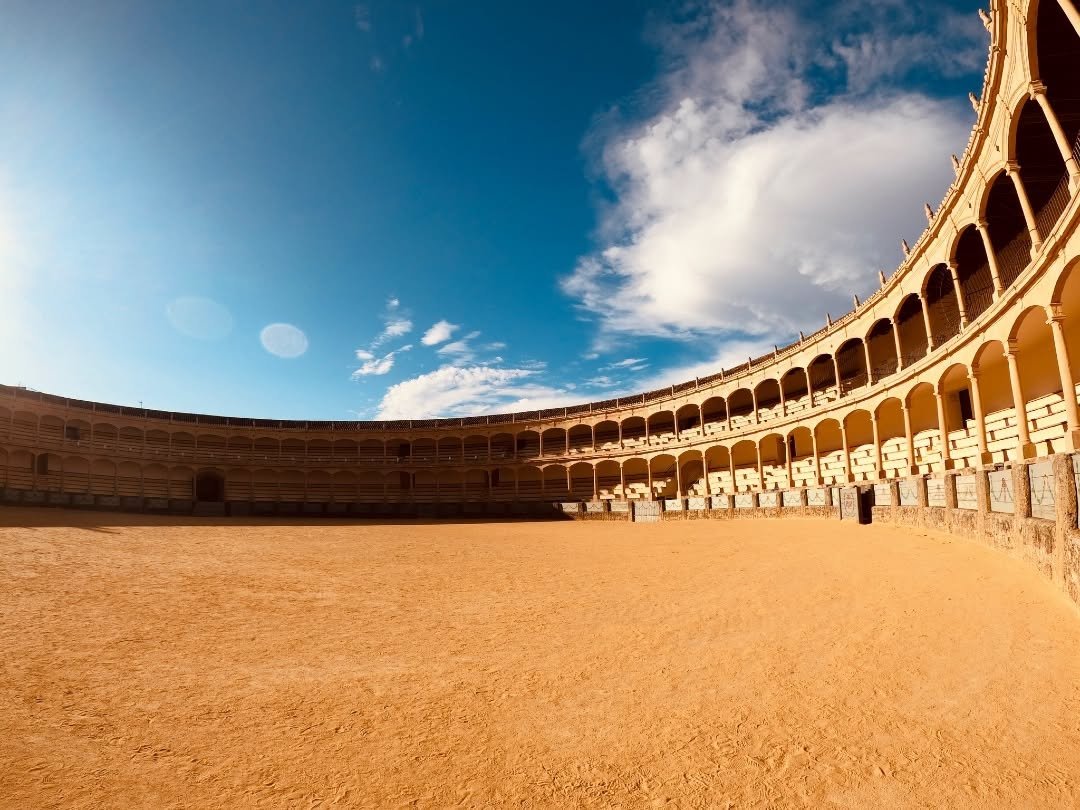
The Plaza de Toros in Ronda is one of the city’s most important historic landmarks and one of the most significant bullrings in Spain. Built in the 18th century, it is closely associated with the Romero family and the development of the Ronda style of bullfighting.
Today, visitors can explore the historic bullring and its museum to learn about Ronda’s role in Spanish culture and the history of bullfighting. You don’t need to be interested in bullfighting itself to appreciate the building, its architecture and its place in Ronda’s history.
Visiting the Plaza de Toros
A visit to the bullring includes access to the arena and museum, where you can learn more about Ronda’s bullfighting history and the Romero dynasty.

Planning your visit to Ronda? The Plaza de Toros is one of the city’s key historic attractions. See our Top 10 places to visit in Ronda for more ideas on what to see and do during your stay.
Agatha Christie: The Seven Dials was filmed in Ronda
Ronda’s Plaza de Toros features in the Netflix miniseries Agatha Christie: The Seven Dials, an adaptation of Agatha Christie’s novel The Secret of Chimneys. Several scenes were filmed in Ronda in September 2024, with the Plaza de Toros among the city’s historic locations used by the production.
The bullring is particularly relevant to the story because the plot has a connection with bullfighting, and it appears in the opening scenes of the series. Other recognisable Ronda locations include the Puente Nuevo, Alameda del Tajo, Arab Baths, Casa del Rey Moro and the area around the Arco de Felipe V.
Would you like to visit a fighting bull farm in Ronda?
Reservatoro Ronda is a working breeding farm for fighting bulls and purebred Andalusian horses, located around 5 km from Ronda. Created by retired bullfighter Rafael Tejada, the farm is open to visitors who can learn about the breeding of fighting bulls and the selection process, while seeing the animals and horses at close quarters.
A visit offers a very different perspective on the traditional world surrounding Ronda’s bullfighting culture and takes you into the countryside just outside the city.

You can book a visit over at Viator.
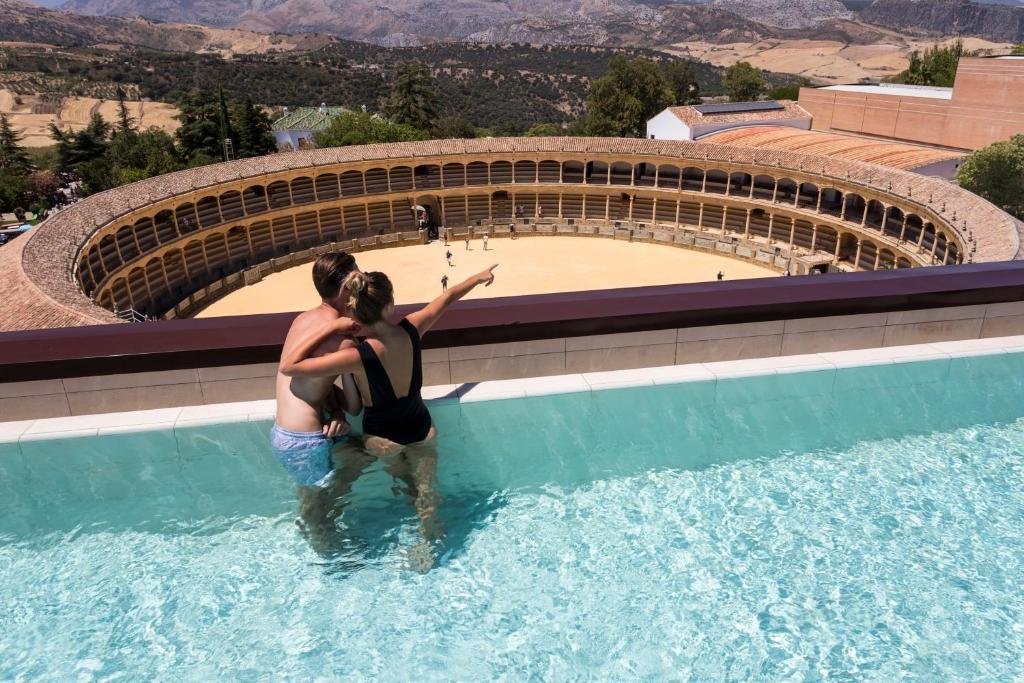
The Hotel Catalonia overlooks the bullring in Ronda
Located in the town centre, right across from the iconic bullring, the Catalonia Ronda boasts an infinity pool, hot tub, and a stunning rooftop terrace offering breathtaking views of the bullring, the square, and the Tajo de Ronda.
The Real Maestranza de Caballería de Ronda.
The Real Maestranza de Caballería de Ronda is the historic institution responsible for the Plaza de Toros and has played an important role in the city’s equestrian and bullfighting traditions for centuries. Founded in 1573, it is one of Spain’s oldest institutions of its kind.

Many tourist guides describe Ronda’s bullring as the oldest and largest in Spain, but that can be misleading. The Plaza de Toros seats around 5,000 spectators, so it is certainly not the largest in terms of capacity. What makes it unusual is the size of its ruedo — the circular arena of sand — which measures 66 metres in diameter. That is larger than the 60-metre ruedo at Madrid’s famous Plaza de Toros de Las Ventas.
A short video showing the Plaza de Toros in Ronda
The first bullfight at Ronda’s Plaza de Toros
Many tourist guides describe Ronda’s bullring as the oldest in Spain, but the history is a little more complicated. Construction of Seville’s Real Maestranza bullring began in 1761, well before work started on Ronda’s Plaza de Toros in 1779. Seville’s bullring, however, took much longer to complete, with the final stonework not finished until 1881.
Ronda’s Plaza de Toros was already being used for bullfighting and other events while construction was still underway. In May 1784, part of the unfinished structure collapsed during a bullfight, forcing the plaza to close while repairs were carried out. The building was finally completed in April 1785 and officially inaugurated on 19 May 1785.
That inaugural corrida featured two of the great names of 18th-century bullfighting, Ronda-born Pedro Romero and his rival Pepe Hillo. The occasion became an important moment in the history of the Plaza de Toros and helped cement Ronda’s reputation as one of the great centres of Spanish bullfighting.

Is Rondas bullring the oldest Spain?
Ronda’s bullring is not the oldest bullring in Spain, but it is unusual in several respects. The Plaza de Toros was designed by José Martín de Aldehuela and is constructed entirely from stone, unlike many historic bullrings that combine stone and brick. Another distinctive feature is that all of the seating is covered.
The stands were constructed on two levels, with five raised rows on each level. A total of 136 Tuscan sandstone columns form 68 arches, supporting the upper seating and the roof of the Plaza de Toros.
The main entrance, completed in 1788 — four years after the ruedo and seating were constructed — was designed and built by Rondeño master stonemason Juan Lamas. It features two tall Tuscan columns and the royal coat of arms of Spain at the centre, surrounded by Baroque decoration. The large entrance was designed to allow horses and carriages to enter the ruedo, while the balcony above features wrought-iron decoration associated with bullfighting.
In 1923, when the original Espinel Theatre was built in Plaza Blas Infante, the main entrance to the Plaza de Toros was moved to Calle Virgen de la Paz, where it remains today, opposite Restaurante Pedro Romero.
The old Espinel Theatre was demolished in the 1980s and replaced by a new theatre in Alameda Park. When the car park next to the Plaza de Toros finally closed in July 2009, a competition was held to design new gardens appropriate to the historic setting. Around the same time, local historians suggested returning the bullring entrance to its original position.
The Feria Goyesca
The Feria Goyesca is one of the most distinctive events in Ronda’s calendar. Created by Ronda-born bullfighting maestro Antonio Ordóñez, the festival takes place in September and includes a bullfight in honour of Pedro Romero, one of the city’s most famous bullfighters.

Read about the Goyesca ladies here.
The event is known for its Goya-inspired costumes. The bullfighters and their assistants wear traditional-style clothing based on the characters and fashions depicted in the paintings of Francisco de Goya, while many spectators dress in elaborate period-inspired outfits.
The event also has strong connections with Ronda’s second great bullfighting dynasty, the Ordóñez family.
The museum in Ronda’s Plaza de Toros, the Museo Taurino, contains many of the most important outfits and bullfighting regalia from the last two centuries, as well as an extensive collection of weapons used by the Real Maestranza during Spain’s many conflicts.
Ronda Bullring Opening Times and Prices
- November–February: 10:00–18:00
- March & October: 10:00–19:00
- April–September: 10:00–20:00
- General admission: €10
- With audioguide: €12
- Group rate: €8
Audioguides are available in several languages, including English
IMPORTANT: Except during the Pedro Romero Goyesca feria in the first week of September
For group bookings, please phone the ticket office +34 952 874 132 or send an email taquilla@realmaestranza.org
Further reading:
- Top 10 Things to Do in Ronda – Discover the city’s most important sights, attractions and experiences.
- Bullfighting History in Ronda – Learn more about Ronda’s long association with bullfighting and the famous Romero and Ordóñez families.
- Reservatauro Ronda – Visit a working fighting bull and Andalusian horse breeding farm just outside Ronda.
FAQ: Plaza de Toros in Ronda, Spain
Yes, particularly if you’re interested in Ronda’s history, architecture and Spanish culture. You don’t have to be interested in bullfighting to appreciate the historic building, its unusual covered seating, the 66-metre ruedo and the Museo Taurino.
The Plaza de Toros was officially inaugurated on 19 May 1785, although bullfighting events were held there before construction was fully completed.
The Plaza de Toros was designed by José Martín de Aldehuela, the architect also responsible for several important buildings and structures in Ronda.
It’s Spain’s most prestigious knightly order, established after the Christian reconquest of Ronda in 1485. The order is closely tied to equestrian traditions and uses the bullring as its ceremonial and administrative home.
Yes, you can visit Reservatauro Ronda, a working bull and Andalusian horse breeding farm just 5km from Ronda. Founded by retired bullfighter Rafael Tejada, it offers guided tours where guests can learn about the animals and their training.
Held each September, the Feria Goyesca is a bullfighting festival in honour of Pedro Romero. Matadors wear Goya-style costumes, and the city embraces traditional dress and pageantry. It’s Ronda’s most iconic annual event.
Located within the bullring, the Museo Taurino displays historic bullfighting outfits, artwork, and an impressive collection of weapons used by the Real Maestranza during Spain’s military past.
Yes, but only once a year during the Feria Goyesca. Outside this event, the bullring is used as a museum and historical site rather than a functioning arena for regular bullfights.

I’ve been living in this lovely area of Western Andalucia for the last 20 years or so and dedicate most of my time to the running of English language tourist information websites for the towns of Cádiz, Ronda, Grazalema, the famous or infamous Caminito del Rey, and also Wildside Holidays, which promotes sustainable and eco-friendly businesses running wildlife and walking holidays in Spain. My articles contain affiliate links that will help you reserve a hotel, bus, train or activity in the area. You don’t pay more, but by using them you do support this website. Thankyou!
Shame on you for murdering defenceless creatures.
Sick sick cowards.
*Boycott Spain*