Explore the historic monuments of Ronda, from ancient city walls and churches to iconic bridges and plazas. Discover the rich history and architectural heritage of this Andalusian town.
Visitors to Ronda are often confused as to why our central plaza Socorro features a statue of a semi-naked man with two lions by his side and a couple of pillars behind him. What is their significance? Lets find out about the Plaza del Socorro and Blas Infante.
The answer lies in Andalusian nationalism and one of the most important events in recent Andalusian political history. The Assembly of Ronda in 1918. This was when the father of Andalusian nationalism, Blas Infante, unfurled the flag and symbols of Andalusia whilst standing on the first floor balcony of the ‘Circulo de Artistas‘. The building directly behind the fountain with red CA lettering above the windows.
I’ve been living in this lovely area of Western Andalucia for the last 20 years or so and dedicate most of my time to the running of English language tourist information websites for the towns of Cádiz, Ronda, Grazalema, the famous or infamous Caminito del Rey, and also Wildside Holidays, which promotes sustainable and eco-friendly businesses running wildlife and walking holidays in Spain. My articles contain affiliate links that will help you reserve a hotel, bus, train or activity in the area. You don’t pay more, but by using them you do support this website. Thankyou!
Standing on Plaza Duquesa de Parcent, Santa María la Mayor is Ronda’s most important historic church. Its distinctive tower and broad façade make it look almost like a civic building, but behind its doors lies one of the city’s most remarkable stories.
The church occupies a site that has served as a place of worship for centuries. The present building stands on the remains of the city’s former mosque, which was transformed into a Christian church after the conquest of Ronda in 1485, creating one of the finest examples of Ronda’s layered history.
I’ve been living in this lovely area of Western Andalucia for the last 20 years or so and dedicate most of my time to the running of English language tourist information websites for the towns of Cádiz, Ronda, Grazalema, the famous or infamous Caminito del Rey, and also Wildside Holidays, which promotes sustainable and eco-friendly businesses running wildlife and walking holidays in Spain. My articles contain affiliate links that will help you reserve a hotel, bus, train or activity in the area. You don’t pay more, but by using them you do support this website. Thankyou!
Ronda’s Arab Baths (Baños Árabes) are one of the best-preserved medieval Islamic bath complexes in the Iberian Peninsula. Located beside the Puente Árabe in the former Muslim suburb of San Miguel, the baths give a fascinating insight into daily life in medieval Ronda and the importance of bathing, cleanliness and socialising in an Islamic city.
The baths date from the 13th and 14th centuries and retain much of their original layout and hydraulic system. The complex includes separate cold, warm and hot rooms, together with the remains of the furnace, aqueduct and water-lifting system that supplied the hammam. The surviving star-shaped skylights, horseshoe arches and water system make it one of the most interesting Moorish monuments in Ronda.
I’ve been living in this lovely area of Western Andalucia for the last 20 years or so and dedicate most of my time to the running of English language tourist information websites for the towns of Cádiz, Ronda, Grazalema, the famous or infamous Caminito del Rey, and also Wildside Holidays, which promotes sustainable and eco-friendly businesses running wildlife and walking holidays in Spain. My articles contain affiliate links that will help you reserve a hotel, bus, train or activity in the area. You don’t pay more, but by using them you do support this website. Thankyou!
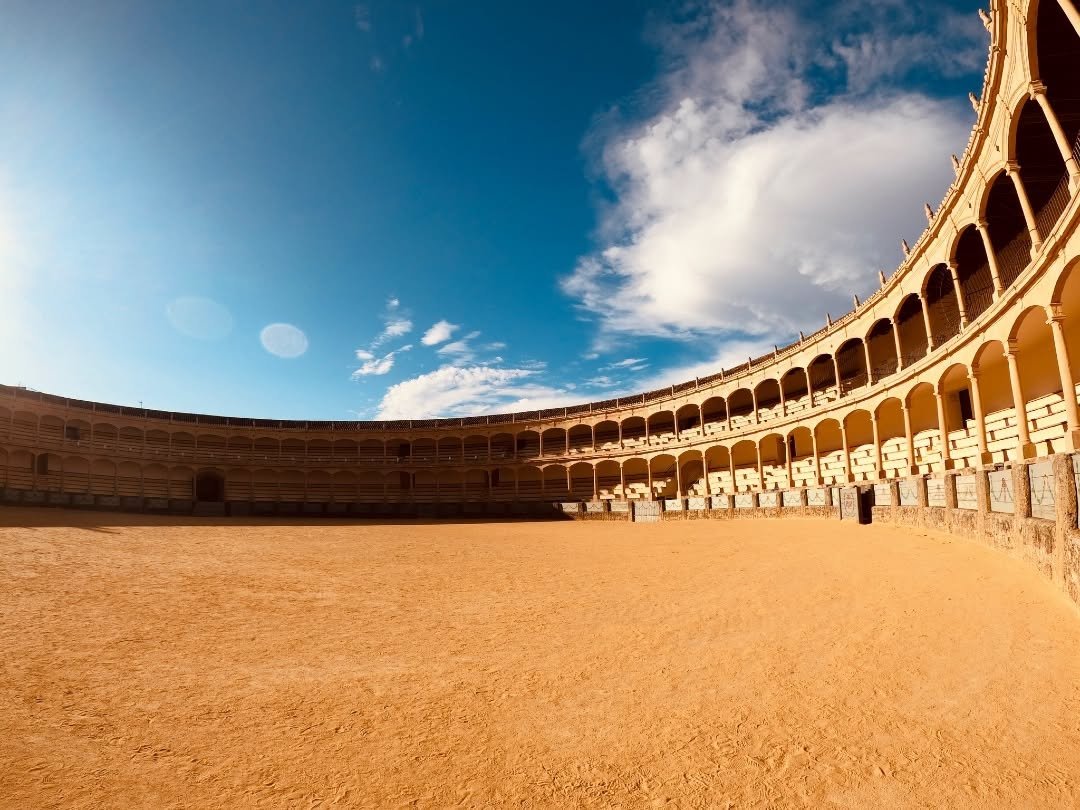
The Plaza de Toros in Ronda is one of the city’s most important historic landmarks and one of the most significant bullrings in Spain. Built in the 18th century, it is closely associated with the Romero family and the development of the Ronda style of bullfighting.
Today, visitors can explore the historic bullring and its museum to learn about Ronda’s role in Spanish culture and the history of bullfighting. You don’t need to be interested in bullfighting itself to appreciate the building, its architecture and its place in Ronda’s history.
Visiting the Plaza de Toros
A visit to the bullring includes access to the arena and museum, where you can learn more about Ronda’s bullfighting history and the Romero dynasty.
Planning your visit to Ronda? The Plaza de Toros is one of the city’s key historic attractions. See our Top 10 places to visit in Ronda for more ideas on what to see and do during your stay.
Agatha Christie: The Seven Dials was filmed in Ronda
Ronda’s Plaza de Toros features in the Netflix miniseries Agatha Christie: The Seven Dials, an adaptation of Agatha Christie’s novel The Secret of Chimneys. Several scenes were filmed in Ronda in September 2024, with the Plaza de Toros among the city’s historic locations used by the production.
The bullring is particularly relevant to the story because the plot has a connection with bullfighting, and it appears in the opening scenes of the series. Other recognisable Ronda locations include the Puente Nuevo, Alameda del Tajo, Arab Baths, Casa del Rey Moro and the area around the Arco de Felipe V.
Would you like to visit a fighting bull farm in Ronda?
Reservatoro Ronda is a working breeding farm for fighting bulls and purebred Andalusian horses, located around 5 km from Ronda. Created by retired bullfighter Rafael Tejada, the farm is open to visitors who can learn about the breeding of fighting bulls and the selection process, while seeing the animals and horses at close quarters.
A visit offers a very different perspective on the traditional world surrounding Ronda’s bullfighting culture and takes you into the countryside just outside the city.
Reservatauro Ronda is an active breeding farm for fighting bulls and purebred Andalusian horses, situated just 5 kilometers from Ronda.
I’ve been living in this lovely area of Western Andalucia for the last 20 years or so and dedicate most of my time to the running of English language tourist information websites for the towns of Cádiz, Ronda, Grazalema, the famous or infamous Caminito del Rey, and also Wildside Holidays, which promotes sustainable and eco-friendly businesses running wildlife and walking holidays in Spain. My articles contain affiliate links that will help you reserve a hotel, bus, train or activity in the area. You don’t pay more, but by using them you do support this website. Thankyou!
The House of the Giant, otherwise known as the Casa del Gigante in Ronda’s old city is one of the most complete examples of Nasrid architecture outside of Granada and definitely a destination that should be on your list of places to see in Ronda.
This house is located in a quiet plaza behind the Santa Maria La Mayor church, and directly across from the Museo Peinado. The Casa del Gigante is just 2 minutes walk from the Puente Nuevo and Plaza d’España, and not too far from the Mondragon Palace. A statue of Vincent Espinel is located directly in front of the entrance to the House of the Giant.
The palace was already more than 100 years old at the time of the fall of Ronda to Ferdinand’s army in 1485 and apart from some redecorating in the 17th century is still largely complete as a Moorish building.
I’ve been living in this lovely area of Western Andalucia for the last 20 years or so and dedicate most of my time to the running of English language tourist information websites for the towns of Cádiz, Ronda, Grazalema, the famous or infamous Caminito del Rey, and also Wildside Holidays, which promotes sustainable and eco-friendly businesses running wildlife and walking holidays in Spain. My articles contain affiliate links that will help you reserve a hotel, bus, train or activity in the area. You don’t pay more, but by using them you do support this website. Thankyou!
For nearly 700 years Ronda was an Islamic city, and during this time is believed to have had 7 or 8 mosques, none of which exist today, except for the San Sebastian Minaret (Alminar de San Sebastián) which was converted into a bell tower after the adjacent mosque was reconsecrated a Christian church.
It was here in 1485 that Ferdinand II is believed to have ordered a mass to offer thanks for the capture of Ronda.
Brick work on the San Sebastian Minaret (Alminar de San Sebastián)
The mosque wasn’t particularly large, but being the closest to the central mosque frequented by the city’s rulers and elite families, the mosque in Plaza Abul Beka probably served as the main mosque for merchants and middle ranking families of the city.
I’ve been living in this lovely area of Western Andalucia for the last 20 years or so and dedicate most of my time to the running of English language tourist information websites for the towns of Cádiz, Ronda, Grazalema, the famous or infamous Caminito del Rey, and also Wildside Holidays, which promotes sustainable and eco-friendly businesses running wildlife and walking holidays in Spain. My articles contain affiliate links that will help you reserve a hotel, bus, train or activity in the area. You don’t pay more, but by using them you do support this website. Thankyou!
Welcome to the vibrant and captivating city of Cordoba, nestled in the heart of Andalusia! As the sun cast its fiery August glow upon the historic streets, my family and I embarked on a family adventure in historic Cordoba that combined the rich tapestry of Cordoba’s past with the energy of two grown ups and three curious kids, aged 14, 14, and 9.
August’s fierce heat with temps as high as 46C didn’t deter us from uncovering the treasures this enchanting city has to offer. From awe-inspiring architecture to delightful culinary experiences, our exploration was a blend of education, culture, and pure fun. With 5 sets of eagle eyes and the help of Google maps, it was also pretty easy for us to find great places to eat as well.
I’ve been living in this lovely area of Western Andalucia for the last 20 years or so and dedicate most of my time to the running of English language tourist information websites for the towns of Cádiz, Ronda, Grazalema, the famous or infamous Caminito del Rey, and also Wildside Holidays, which promotes sustainable and eco-friendly businesses running wildlife and walking holidays in Spain. My articles contain affiliate links that will help you reserve a hotel, bus, train or activity in the area. You don’t pay more, but by using them you do support this website. Thankyou!